
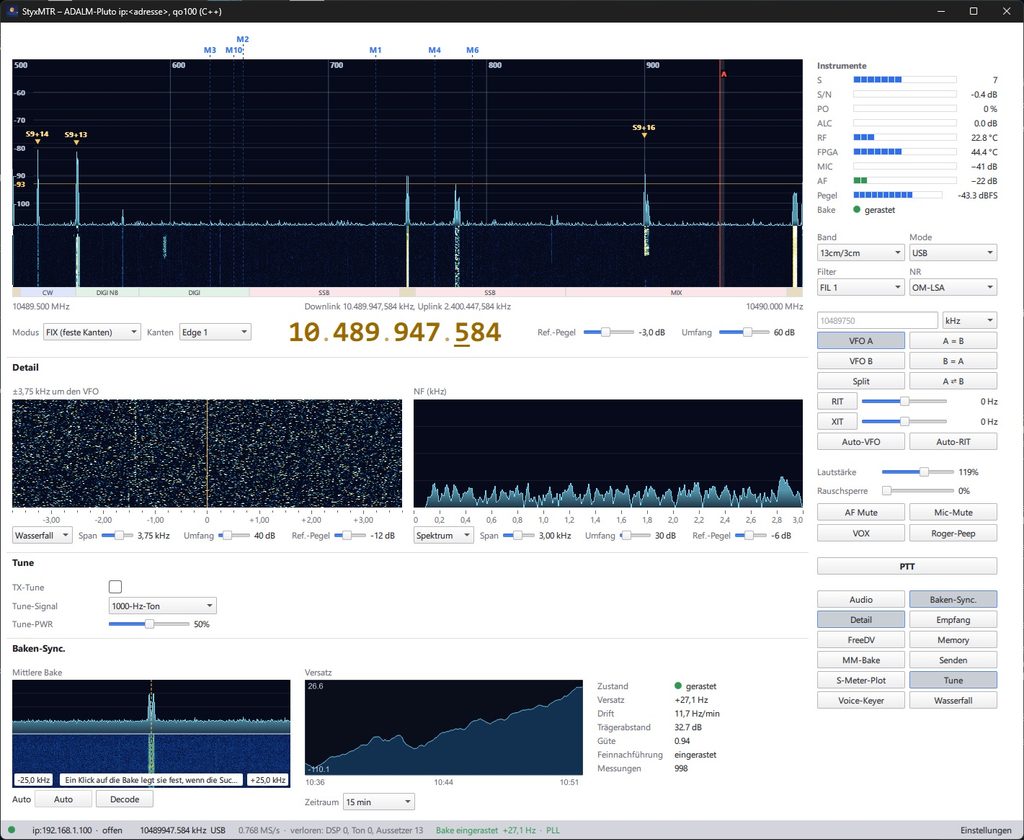
StyXmtr is a spin-off application from the LogRunner Suite. It supports the ADALM-Pluto and Pluto Plus and enables operation via QO-100.
StyXmtr was developed based on experience with PlutoTRX, which was implemented in Python. Claude Code rewrote StyXmtr in C++ for Windows 11, Raspberry Pi 5, and macOS. For time-critical applications, C++ offers significantly better performance than Python.
Why “Styx”?
The name has an astronomical origin: Styx is one of the moons of the dwarf planet Pluto. The application supports the Pluto hardware, and so StyXmtr, in a sense, orbits the hardware for which it was developed.
Three Modes of Use
StyXmtr can be used in three ways:
- Standalone application with its own user interface
- Backend in the LogRunner environment
- Bridge application on the Raspberry Pi 5 that connects the ADALM Pluto or Pluto Plus to the station computer via Wi-Fi
The backend and frontend are clearly separated in StyXmtr. This also allows for customizations to the user interface, such as touch control on a 10-inch display connected to the Raspberry Pi 5.
Why not just use C++?
C++ is a compiled language: Every change to the code must first be compiled, and that takes time. Python is an interpreted language, so changes can be tested immediately.
The entire LogRunner project was developed without a “script.” So for me, the transition from Python to C++ wasn’t a waste of time—quite the opposite: In the Python prototype, I was able to quickly try out, discard, and refine ideas. Claude Code implemented StyXmtr in less than a week. Without the Python code created earlier, it would have taken significantly longer.
Download
https://github.com/DL1EGL/StyXmtr/releases
VY 73, Robert – DL1EGL